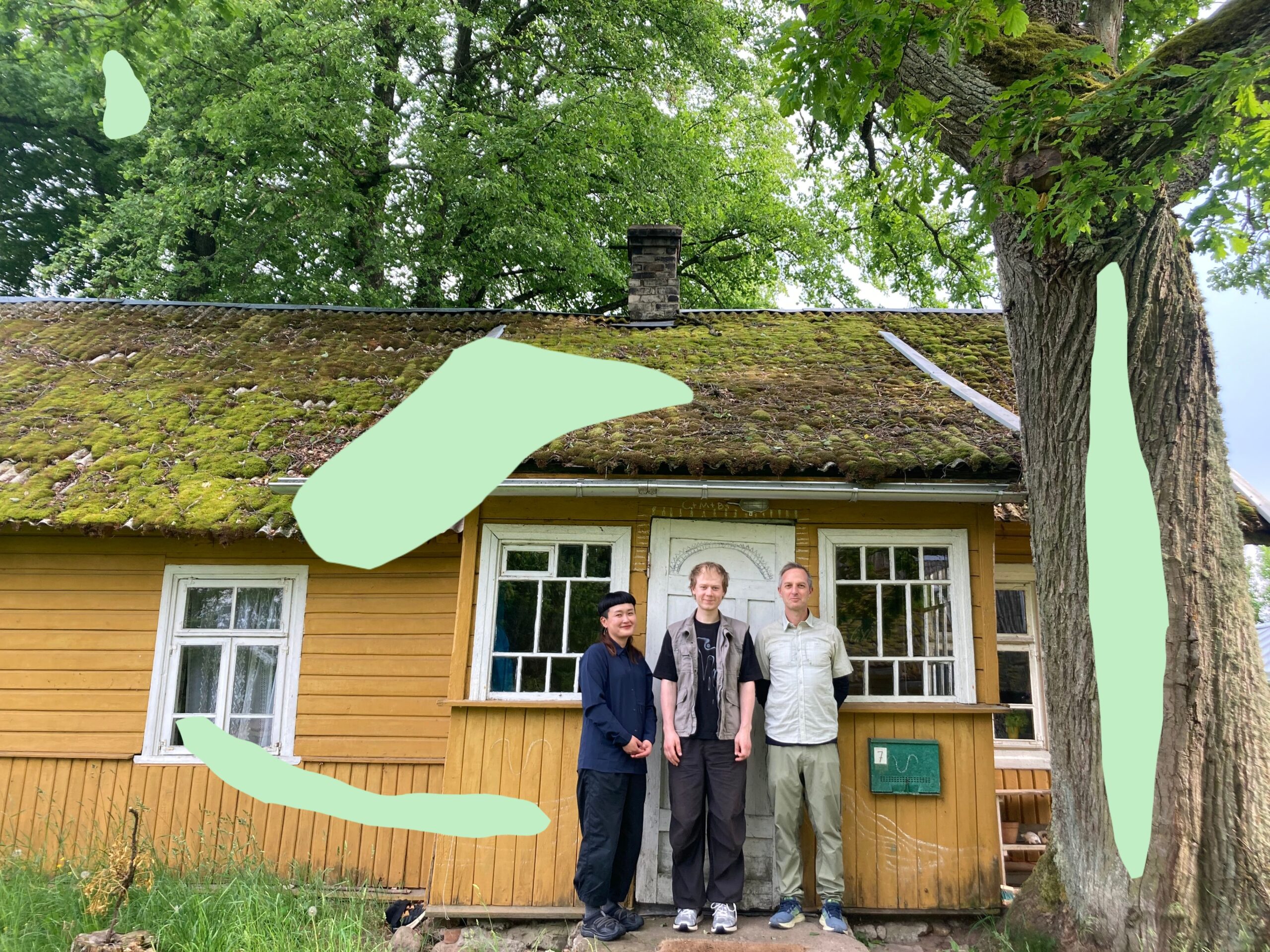
June, July residents – Jokūbas Vaicekauskas, Hiroko Tsuchimoto and Jack Faber
During the months of June and July, the skudde sheep flock is herd by three artists.
Jokūbas Vaicekauskas is a curiosity-based artistic researcher and artist interested in unconventional methods and ways in which research could be carried out. With a specific focus on surrounding-specific investigations, highlighting the process. On the second day of Verpėjos residency, he decided to learn how to climb a tree with “Geinys”, a structure woven from ropes and specific wood carvings, an old traditional method of tree beekeeping.
Hiroko Tsuchimoto is a Japanese-born, Stockholm-based visual artist whose practice moves across participatory performance, drawing, walking, textile work, fermentation, and gardening. Her work takes as its premise the continuity between human and more-than-human life, questioning the ontological separations through which Western modernity has organized nature, otherness, and belonging. Tsuchimoto is beginning her residency practice by extracting lanolin from raw wool, the oily substance that protects sheep’s skin. Through this process, she explores the possibility of moving from discomfort toward intimacy, guided by touch.
Jack Faber is a Helsinki-based artist-researcher whose work investigates narratives of species survival and surveillance. Highlighting their covert interconnections and role in the ecological crisis, his interdisciplinary practice focuses on Militarized nature and its accelerated landscapes. He uses drones, phones and new technologies in unexpected ways, often altering them into means of questioning the securitization of public spaces and contested territories. In his work Jack examines possibilities of emancipatory engagements through a hybrid of salvaged footage, archival materials, documentation, scripted texts and participatory practices. He sensitively uses humor, transgression, and immersion for in-depth explorations of inequality and oppression in relation to animals, AI, and human rights.
During his residency in Kabeliai, Jack Faber is developing research for a new body of work examining border landscapes, more-than-human movement, and the changing relationship between ecology and security. Working in close proximity to the Belarusian border, he explores how contemporary geopolitical tensions become embedded within everyday rural environments.
Photo: Laura Garbštienė
Graphic design: Inga Navickaitė-Drąsutė